 University of North Texas


NeuroWheel: Neuroinformatics & Real-Time EEG-to-Navigation Assistive Vehicle
NeuroWheel: Neuroinformatics & Real-Time EEG-to-Navigation Assistive Vehicle
Current Students: Tareni Moorty, Soham Sharma
Faculty Mentor: Pretom Roy Ovi
Status: Current
NeuroWheel bridges the gap between neural intent and physical movement. Combining advanced neuroinformatics with real-time EEG-to-navigation pipelines, this system translates Brain-Computer Interface (BCI) signals into precise digital navigation—empowering individuals with physical disabilities to navigate immersive environments safely and independently using non-invasive, consumer-grade technology. The objectives include:
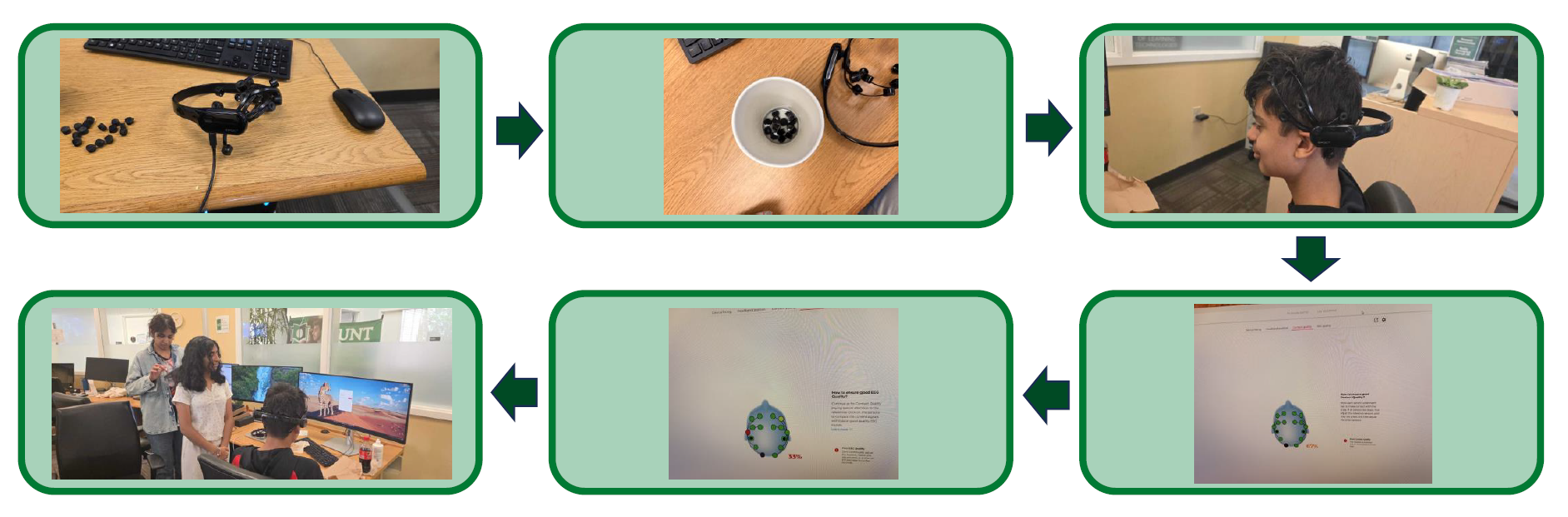 (Using the Emotiv EPOC-X)
1. Real-Time EEG Acquisition & Neural Signal Pipeline
Establishing a high-fidelity neuroinformatics data stream from scalp to software.
To navigate virtual spaces safely and responsively, the system requires a clean, uninterrupted feed of brain activity. Using an Emotiv wireless EEG headset, we capture continuous scalp potentials at a sampling rate of 128 Hz. Hardware Link & Stream Setup: Connects wirelessly via the Emotiv Cortex API. Pre-session diagnostics check channel impedance to ensure optimal electrode contact quality across all 14 sensor location.
2. User Calibration & Intent Classifier Training
Translating raw neural patterns into distinct EEG-to-navigation control inputs.
Every user’s brain signature is unique. This stage focuses on training machine learning models tailored to individual Motor Imagery (MI) signals (e.g., imagining hand or foot movement) and multi-paradigm BCI triggers. Through guided calibration protocols, the neuroinformatics pipeline maps distinct mental tasks directly to navigation control inputs: forward, reverse, left, right, and immediate stop.
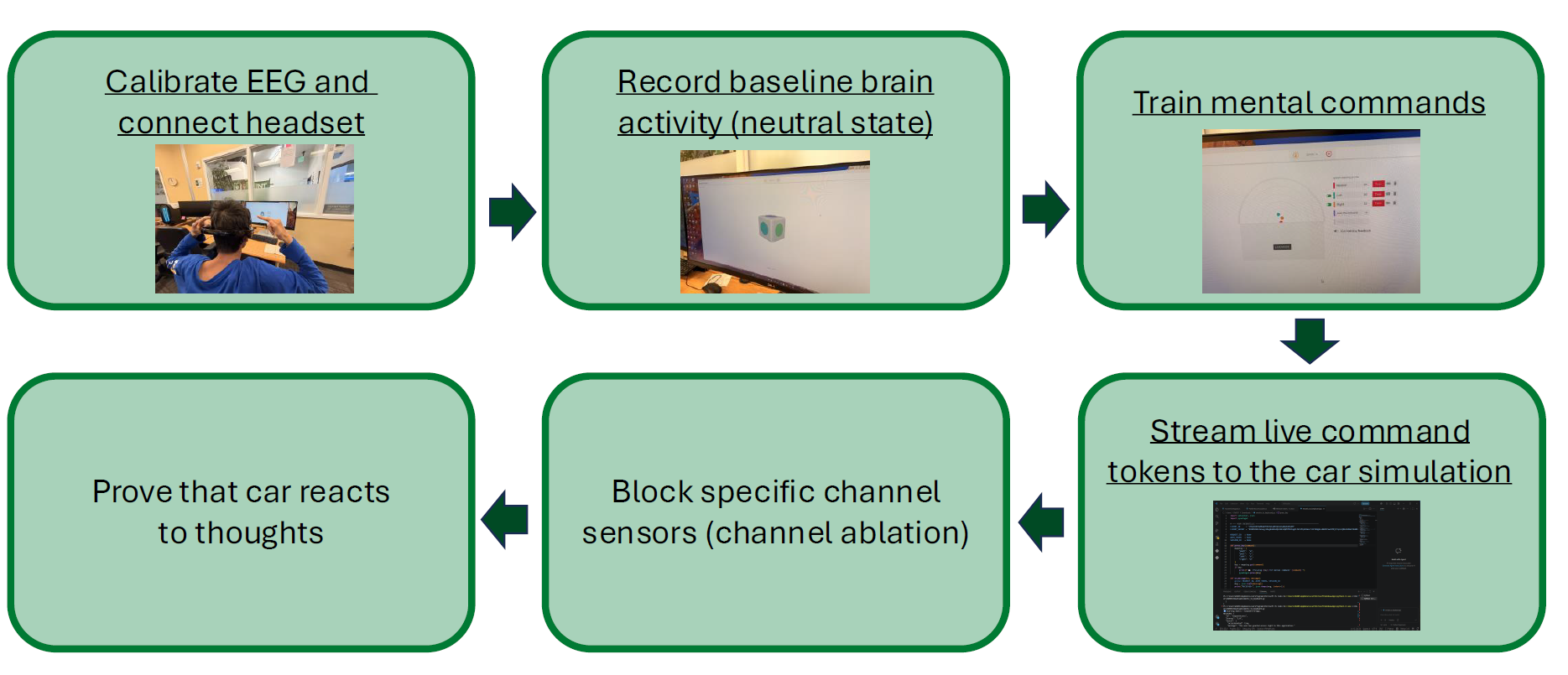
3. Unity 3D VR Environment Integration, Safety Design & Real-World Simulation
Executing neural navigation inside an immersive virtual reality space.
With the classification engine active, the EEG-to-navigation pipeline streams directly into a custom-built Unity 3D VR environment. This immersive setup serves as a risk-free, highly adaptable simulation bed for testing BCI-controlled mobility before physical deployment.
-
Virtual Vehicle Control: Neural commands are sent over socket communication to drive a virtual wheelchair or assistive avatar within realistic 3D spaces (e.g., home interiors, outdoor paths, obstacle courses).
-
Real-Time Simulation Testing: Evaluates decision latency, path accuracy, and maneuverability across varied VR scenarios.
-
Interactive Safety & Hazards: Features dynamic obstacles and collision boundaries within Unity to validate immediate stop commands and safety overrides in real time.
 |
 |
 |
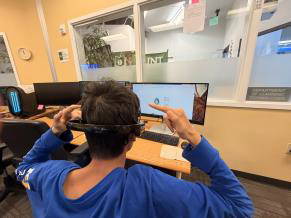
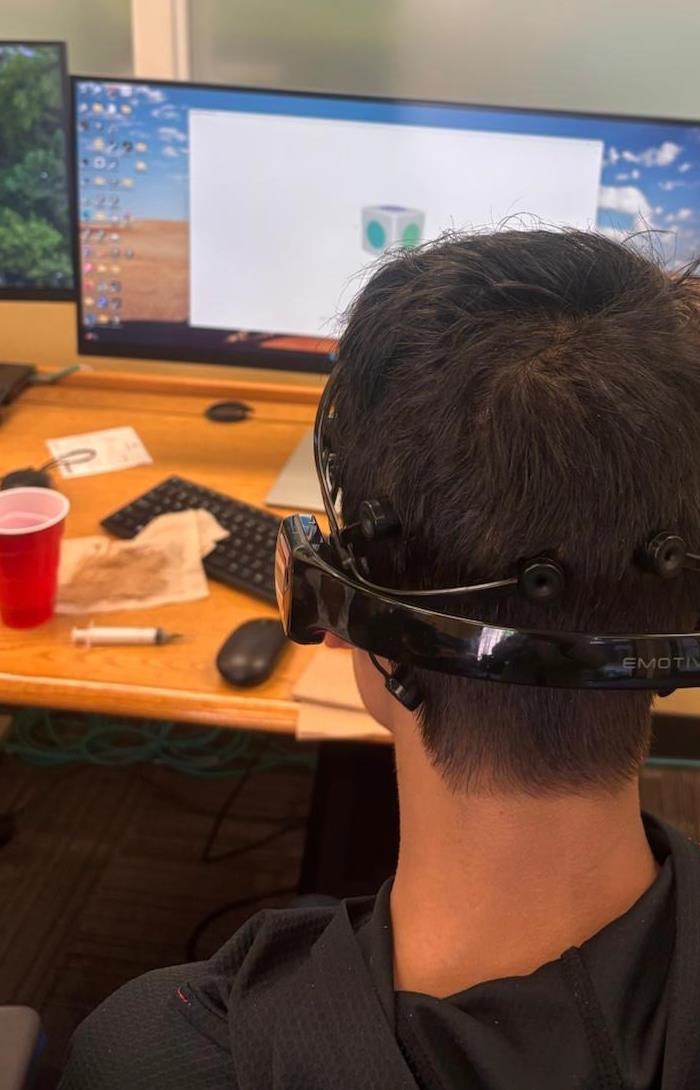
| Calibrate EEG and connect headset | Emotiv EPOC-X acts as a microphone by listening to the neurons firing rapidly. | Use of machine learning model to detect EMOTIV brain signals real time and dashboard during the car simulation. |
Publications
- Moses,P.A., Bajaj, A., Panemangalore,O., Sharma,S., Ovi, P.R., "Immersive AR/VR Annotation of Point Clouds for Indoor Digital Twin Applications", Proceedings of the 13th Annual Conf. on Computational Science & Computational Intelligence (CSCI'26), December, 16-18, 2026
DVXR LABORATORY (C) 2022-2026, ALL RIGHTS RESERVED